
Coryell Projected Versus Actual Release
A projected date is a calculation, not proof that a person walked out. For a person committed to the Texas Department of Criminal Justice, the Projected Release Date estimates when incarceration will end if parole does not occur first. TDCJ Classification and Records calculates it from the offense title, offense date, sentence, and the time-credit rules that apply. The record can change as legal status and credits change.
A Scheduled Release Date is closer to an exit. It may appear after a favorable release decision, receipt of a release certificate, and a records audit. TDCJ still warns that a scheduled date and location can change without notice. The actual release record documents the completed event. Final discharge is different again: it can mean the sentence and any parole or mandatory supervision have ended.
A pretrial detainee at Coryell County Jail does not receive a TDCJ projection. Bond, dismissal, transfer, a court ruling, or sentence completion can control the next step. The live jail roster answers whether the person is presently held, while the jail record and court file explain what happened afterward.
Find a Coryell Projected Release Date
Begin with the system that holds the person. The six TDCJ units in Coryell County are state prisons, even though they share the county's location. A move from the Coryell jail into Woodman intake or another TDCJ unit is continued custody, not community release. For a state prisoner, the official TDCJ Inmate Search is the first check.
- Search by TDCJ or SID number when known. Otherwise use the first and last name, then compare gender, race, offense, and location.
- Open the matching detail and copy the date with its full label. Do not shorten Parole Eligibility Date, Projected Release Date, or Scheduled Release Date to “release date.”
- Read the parole review details. A favorable vote can still require a program, transfer, certificate, and audit.
- For a county detainee, check the sheriff roster for current custody, then ask the Sheriff's Records Clerk and the correct court for the release authority and actual entry.
- After the date passes, confirm the event in TDCJ or county records. The broader Coryell County released-inmate process is covered on the home search and records page.
The TDCJ form accepts last name, first name, TDCJ number, SID number, gender, and race. Numbers are stronger than a same-name match. TDCJ also offers email and telephone information routes. A caller without a TDCJ or SID number must provide the exact date of birth.
The official TDCJ search form shows the identifiers available for a Coryell County state-prison lookup.
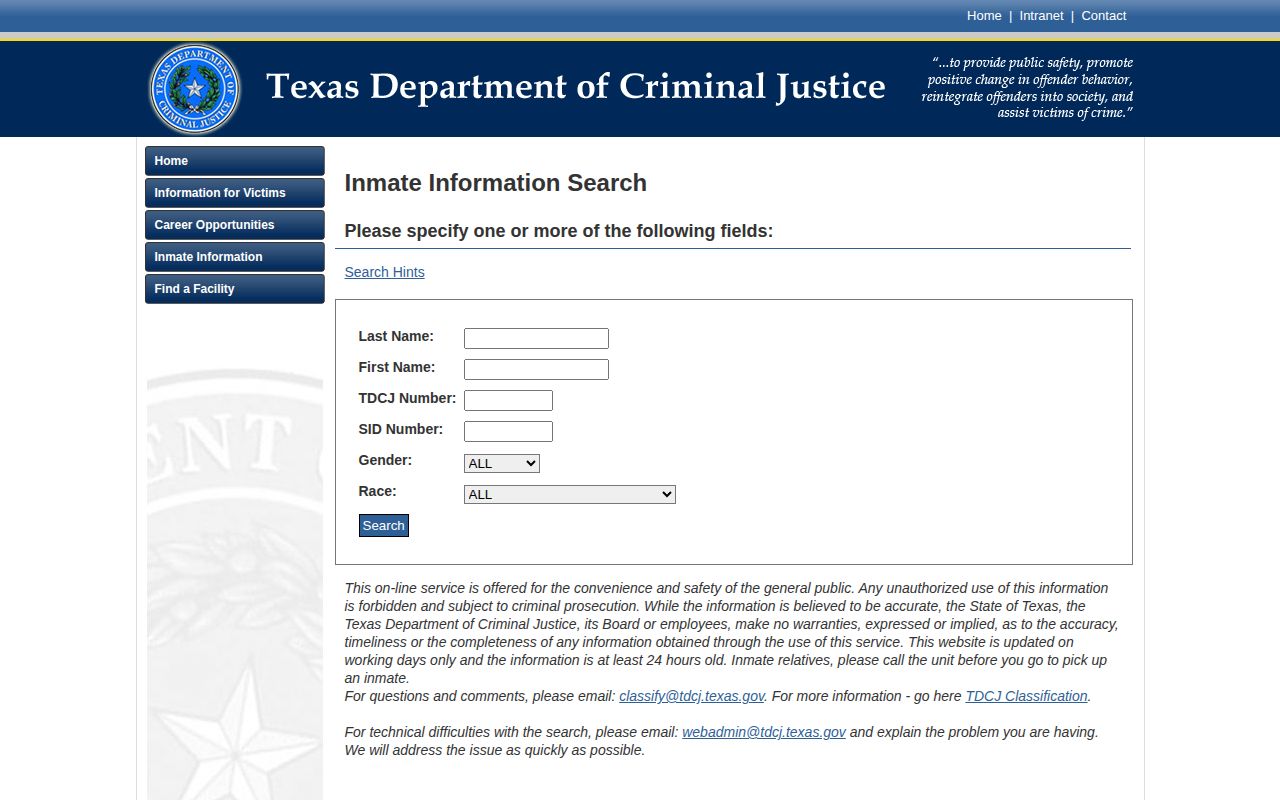
The form is a starting point. The matching detail and its precise label determine whether a displayed date is projected, eligible, or scheduled.
Coryell State Release Time Credits
Texas Government Code Chapter 498 governs state good-conduct time. TDCJ awards classifications of good time under state rules, and disciplinary action can reduce or forfeit credits. Those credits can affect eligibility and a projected mandatory-supervision calculation. They do not simply erase part of every prison sentence, and they do not create an automatic right to parole.
Offense law matters. Government Code Chapter 508 sets parole and mandatory-supervision rules, including ineligible categories and offense-date distinctions. Some parole eligibility formulas count calendar time plus good conduct time. Serious categories can require stated portions of the sentence in actual calendar time. A favorable eligibility date only permits review.
No Coryell-specific public formula was found for a short county-jail sentence. Do not apply the state-prison credit formula to a county detainee. Obtain the judgment, jail-time credit, and actual jail release entry instead.
Note: Good time can affect a TDCJ calculation or eligibility, but it does not prove that a Coryell County release occurred.
Why Coryell Release Dates Move
A future date is a snapshot of the record at the time of the search. TDCJ may recalculate it after a Board of Pardons and Paroles decision, a change in time credits, a court action, or a records audit. Another agency's hold can also prevent a community exit even when TDCJ finishes its own release processing.
| Change | Effect on the date or event |
|---|---|
| Good-time loss or restoration | May change eligibility or the projected mandatory-supervision calculation. |
| BPP denial or approval | A denial may move a projection to maximum expiration; a later approval may move it earlier. |
| Program condition | An FI program vote can require more custody, treatment, or transfer before release. |
| Court order or sentence change | Changes the legal basis from which TDCJ or the county computes custody. |
| Detainer or transfer | The person may leave one custodian for another without entering the community. |
| Certificate and records audit | Can produce a scheduled date and location, which remain subject to change. |
Write down the date, label, source, and access date. A screenshot shows what the official tool displayed then. It does not turn a projection into a completed release.
Confirm a Coryell Release Event
For a state prisoner, compare the latest TDCJ detail with the Board's person-specific review result. Before a favorable vote, TDCJ lists 844-512-0461 for BPP status. After a favorable vote, the Parole Division release-status line is 512-406-5202. General locator help is available at 936-295-6371 or 800-535-0283 during the weekday hours stated by TDCJ.
The current county notification platform is Texas IVSS-Counties, not the old generic VINE workflow. An alert can corroborate a transfer or release, but the portal says it is not an official record and a person may disappear after custody ends. Registration steps and limits are explained under VINELink Inmate Search. For durable proof, request the release date and type, release certificate or public portion, release unit and location, and public supervision or discharge status from TDCJ.
County release proof follows a different path. Ask the Coryell Sheriff's Records Clerk for the release screen or log entry and ask the felony or misdemeanor clerk for the judgment, bond order, or disposition. A roster card's disappearance alone does not establish why custody ended.
Three Texas Projection Modes
Texas projections have three distinct modes that matter for people held in Coryell County's state units. For a mandatory-supervision-eligible offense committed before September 1, 1996, TDCJ defines the projected date as the point when flat time plus good time equals the sentence. For an eligible offense on or after that date, mandatory supervision is discretionary and the Board must approve it. A legally ineligible offense generally projects to maximum expiration unless parole happens first.
This distinction explains large changes on a TDCJ result. A discretionary mandatory-supervision denial can move the projected date to maximum expiration. A later approval may move it earlier. Neither display alone records the moment the person left Crain, Hilltop, Hughes, O'Daniel, Murray, Woodman, or another TDCJ location.
Note: Offense date and legal category control the projection mode; the Coryell County location does not change statewide law.
Read Coryell Release Date Labels
Four labels answer four different questions. Keeping them separate prevents a TDCJ planning field from being repeated as an event. The definitions apply to people in state custody at Coryell County units and elsewhere in Texas. They do not supply an exit date for a person held only in the county jail.
- Parole Eligibility Date
- The first point when the law permits parole consideration. It is not a vote, approval, or promise of release.
- Projected Release Date
- TDCJ Classification and Records' estimate of when incarceration may end if parole does not occur sooner, under the applicable time-credit rules.
- Scheduled Release Date
- A date that may follow a favorable decision, release certificate, and records audit. It is closer to departure but can still change.
- Maximum Expiration or Discharge
- The sentence-completion endpoint. TDCJ uses discharge broadly enough to include completion of incarceration and any parole or mandatory supervision.
A physical release to parole begins supervised time in the community; it does not end the sentence. The release record should identify that event, while a later record can establish final discharge. For a Coryell County Jail case, pair the jail's actual exit entry with the court order or judgment instead of looking for these state-prison labels.
No Universal Texas 85% Rule
Texas has no universal rule requiring every state prisoner to serve 85 percent of a sentence. That phrase is often imported from other systems and obscures Texas's offense-specific framework. Government Code Chapters 498 and 508, the Penal Code offense, the offense date, and any mandatory minimum determine how calendar time and good time affect eligibility.
Some categories require a fixed fraction or a stated number of actual years before parole consideration. Others use calendar time plus good conduct time. Mandatory supervision has its own eligibility and discretionary-review rules. None of those formulas guarantees release when eligibility arrives. Parole remains a Board decision, and a program vote may require more work before departure.
The safe wording is exact: “TDCJ displayed a Projected Release Date of [date] when checked,” or “the record showed parole eligibility.” After the event, replace that statement only with verified release, supervision, or discharge information. Precision keeps a planned date from being repeated as a fact.